
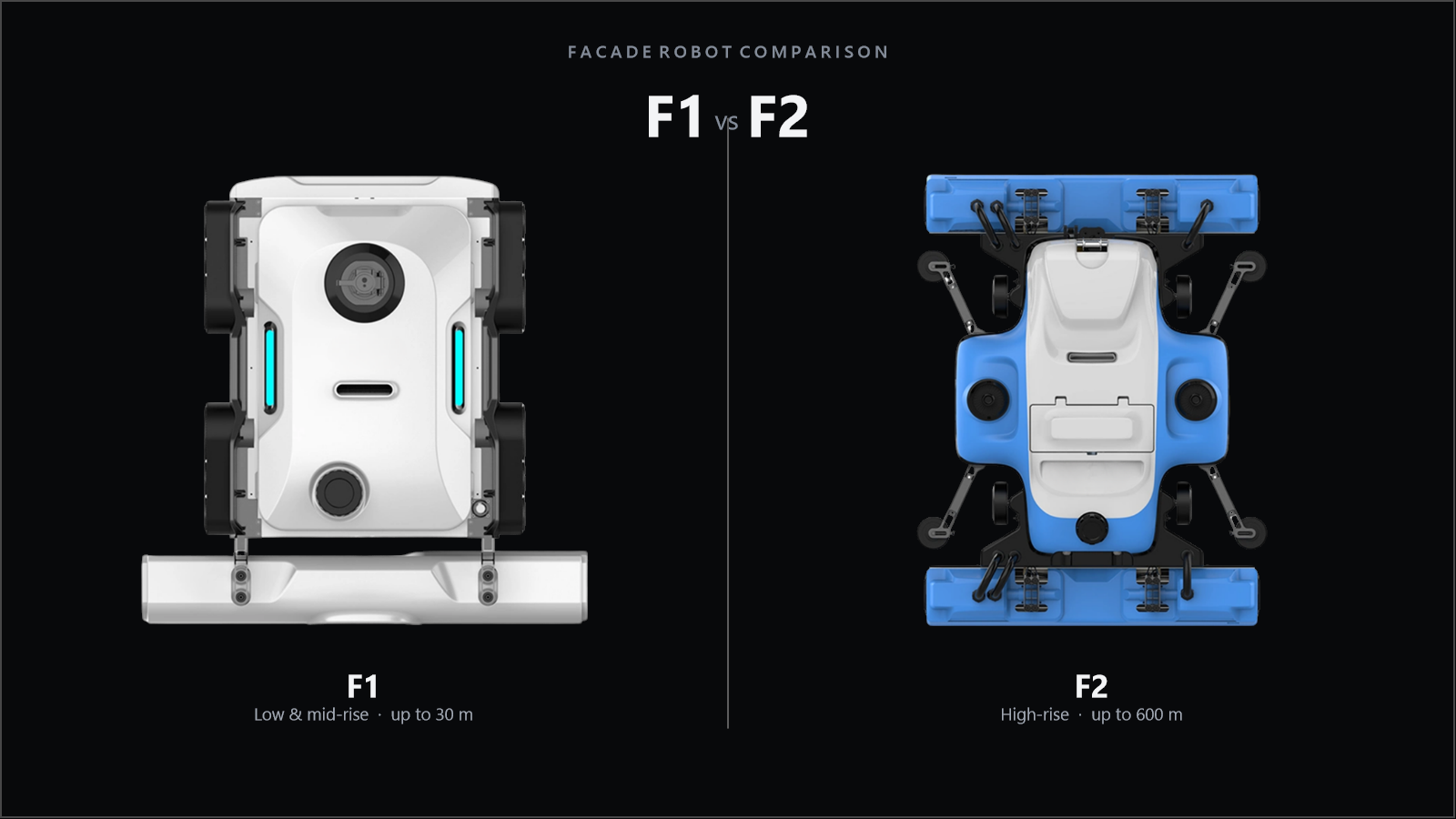
Search "facade cleaning robot" and you'll find machines built for very different jobs, even within the same product line. F1 and F2 are a good example: one is sized for a 6-storey retail block, the other rated for a 40-storey tower, and they solve different problems on purpose. Picking the wrong one for your building either wastes budget on capability you'll never use, or leaves you right back where you started: booking a rope-access crew.
Manual rope-access cleaning is slow, weather-dependent, and carries real fall risk for the crew on the line. That's the problem automated facade robots exist to solve, but only if you match the robot to the building. Teams get this wrong in two directions: over-buying, installing rope-rigging infrastructure and a heavy-duty climber for a low-rise building a compact, rail-free unit could clean in minutes; or under-buying, picking a lightweight suction robot rated for 30 m and expecting it to somehow scale a 200 m curtain-wall tower. Both mistakes come from treating "facade robot" as one category instead of two.
F1: Built for Low & Mid-Rise
F1 is Enerbot's compact climber. Negative-pressure suction holds it to the surface with no rails, ropes, or scaffolding to rig first, and at 28 kg it fits in a car trunk or a building elevator. It's on the wall cleaning within minutes of arriving on site. It's rated up to 30 m, roughly 2 to 15 storeys, cleans an 800 mm-wide pass at up to 432 m² an hour in either wet or dry mode, and rotates a full 360° to reach corners. That makes it the right fit for malls, offices, hotel lobbies, schools, and showrooms: buildings where the facade needs to look sharp without shutting down the sidewalk for a rigging setup.
F2: Built for High-Rise
F2 is the heavier-duty machine, rope-secured as a safety backup, with eight independent suction points spreading the load across flat or curved glass through wind and multi-hour runs. Where F1 trades rigging for portability, F2 trades portability for reach and redundancy: it's rated up to 600 m, tower to podium, cleans a 1,000 mm-wide pass at up to 720 m² an hour (about 2,000 m² a day), locks itself in place automatically if power cuts mid-climb, and keeps working in winds up to level 12. That's the tower and high-rise category: buildings where weather, height, and duty cycle would ground a manual crew for days at a time.
So, Which One Solves Your Problem?
The question isn't which robot is better. It's which one matches the building in front of you. Under roughly 30 m and want a fast, no-rigging deployment? F1 is the fit. Managing a high-rise where wind exposure, height, and duty cycle rule out a lightweight unit? F2 is the fit. And if your portfolio spans both (a retail podium and a tower on the same site, for instance), the answer is often both robots, not a single compromise machine.
Not sure which one your building needs? Tell us about your site and we'll size the recommendation to your building's height, facade material, and access points. No price lists, just a real conversation.